
Frostrail survival: warmth versus health, sealing a heated room, fuel choices, food, bandages, cold damage and the 40 weight Overcumbered cap.
Frostrail Survival: Heat, Food, Weight and Cold Damage
Quick answer: Frostrail runs two survival tracks at once. The train's heat is a resource you spend fuel to keep, and your body has its own warmth, health, stamina and hunger bars. You die when the two fail together: no fuel means a cold cab, a cold cab means a cold body, and a cold body stops regenerating health long enough for a Revenant to finish the job.
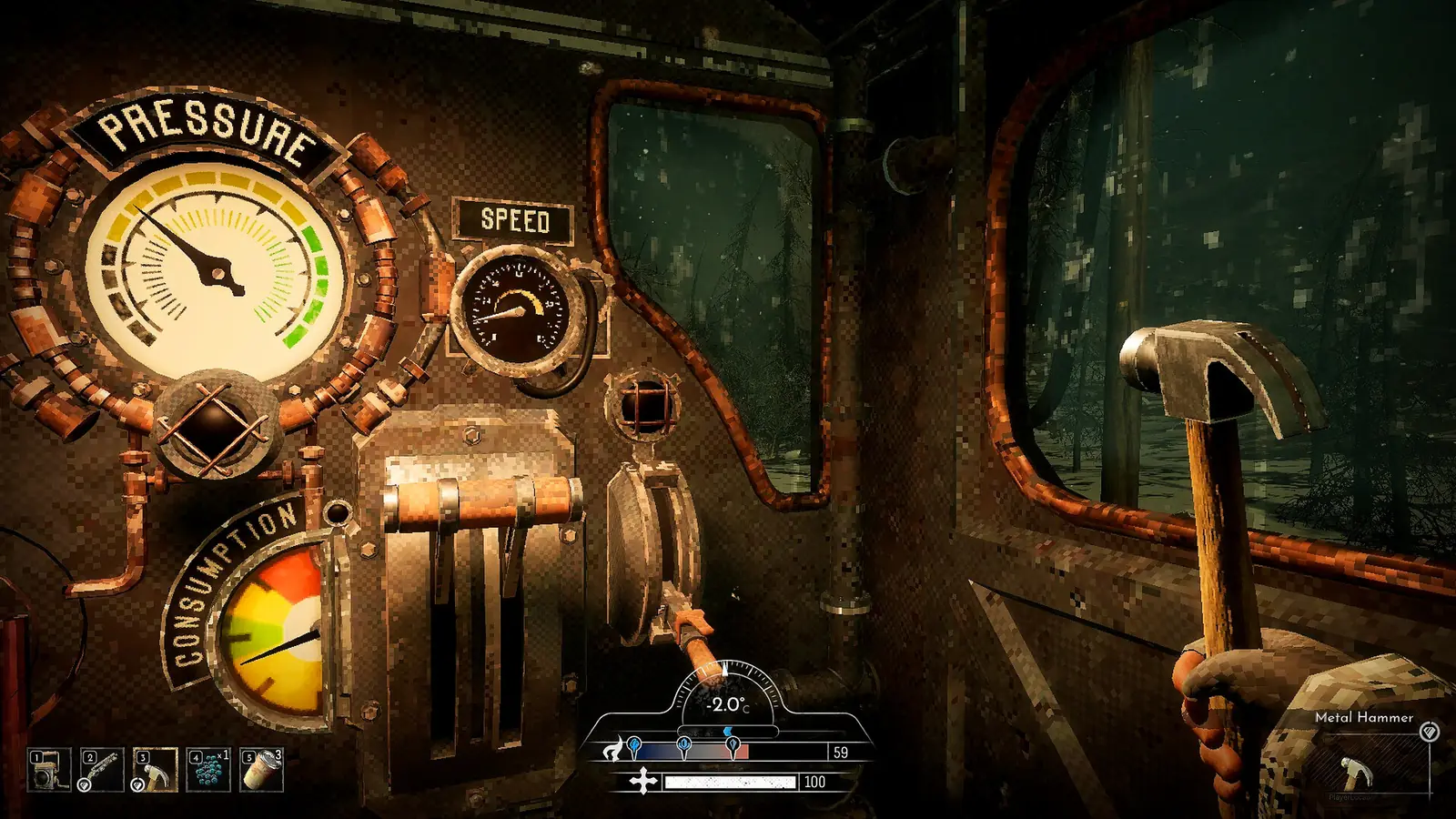
Numbers here come from the demo's own HUD and tooltips. Where the game hides a value we say unknown rather than invent one. Balance will move for Early Access in Q4 2026.
The four meters that matter
| Meter | Range seen in demo | What drains it | What restores it |
|---|---|---|---|
| Warmth | 0-100 | Being outdoors or in an unheated carriage | Standing near a lit engine, heater or fire |
| Health | 0-100 | Cold exposure at 0 warmth, Revenant hits | Bandages (~35 per use in our run), warmth |
| Stamina | 0-100 | Sprinting, jumping, melee swings | Rest; blocked entirely while Overcumbered |
| Hunger | Timer, not a bar | Time and cold | Eating canned food, cooked food, berries |
The Status panel also lists Health Regeneration and Stamina Regeneration, both of which read 0.0/s while cold and over-encumbered. In practice: if you are freezing and loaded with loot, nothing in your body is recovering.
How heat actually propagates
Heat is not a global aura around the locomotive. It comes from two sources and behaves like a volume:
- The Eden Engine heats the cab and the carriages directly connected to it, as long as doors are closed.
- Heaters heat the enclosed space they sit in. A small heater costs roughly five metal scraps; two of them warm a small sealed compartment comfortably.
The consequence is architectural. A carriage with a missing exterior wall is an outdoor space with a roof. Sealing it with a wooden wall and a door turns the same heater into a warm room. This is why the tutorial makes you build a wall before it asks you to light heaters — it is teaching the single most important survival rule in the game.
The character screen shows ambient temperature. Ours read -8.1 °C inside an unheated carriage. If that number is not climbing after you light a fire, the space is not sealed, or the heat source is out.
Fuel: what to burn and what to save
The Eden Engine's hatch accepts burnable items. The in-game fuel tooltip is blunt: logs and branches are the most plentiful and efficient fuel. Everything else is a worse deal.
| Fuel | Verdict |
|---|---|
| Logs | Best all-round fuel; also a crafting material, so keep a reserve |
| Branches | Efficient, lighter than logs, plentiful from recycling |
| Wood scraps | Fine, but better spent on crafting and repairs |
| Clothing, shoes, misc loot | Burns, but you lose the textile scraps it would have yielded |
Recycling is the real fuel economy: a sorting table turns shoes into textile scraps and pans into metal, and the leftovers you cannot use become heat. See resources and recycling for the conversion loop.
Cold damage: when it starts and how it kills
At zero warmth you begin losing health outdoors. The starter suit shows 999% Cold Resistance and 1,000 Armor, but the Cold Resistance stat only mitigates cold — it does nothing against weapons. In practice our character still took cold damage when standing in the open away from the train for long stretches, which suggests resistance slows the drain rather than preventing it.
Rules that kept us alive:
- Never explore further than one sprint from a heat source unless you are deliberately doing a bunker run.
- Carry a torch in dark interiors; light is not warmth, but the bunker is cold and unlit, and getting lost inside costs health.
- Eat before you get cold, not after. Food restores hunger and, in our run, health recovery resumed once warmth came back.
- Drop weight before a cold run. Overcumbered plus cold is the worst possible state: no sprint, no regeneration.
Food and healing in the demo
Confirmed consumables and foods found by looting:
- Canned beans — reliable hunger restore
- Corned beef — heavier can, same role
- Berries — small hunger restore, common in the snow
- Bandages — roughly 35 health per use, crafted from textile scraps or found in houses
There is no visible cooking station requirement for canned food — you open and eat it. A mess workstation exists as a craftable station, which strongly implies cooked meals in Early Access, but the demo did not give us a recipe that needed it (unknown).
Weight: the survival stat nobody expects
At 40.4 / 40 the game labels you Overcumbered, halves movement speed and stops stamina regeneration. That turns a loot run into a slow walk through a blizzard with a Revenant behind you.
A working loadout at 38-39 weight:
- Zip gun, crowbar, wrench, mallet (tools are light, leave them equipped)
- 6-10 rounds of scrap ammunition
- 2 bandages
- 1 can of food
- 10-15 metal scraps, 10 wood scraps
- Everything else: recycle or leave
Early Access changes to expect
The official Spring 2026 update promised persistent progression between stops, relics that buff the train when carried aboard, multiple exits per level, a reworked dungeon layout and dedicated repair workstations. None of that changes the core rule above: heat is a budget, and the train is the only place that refills it.
Read next: Eden Engine upkeep for the machinery, train upgrades for carriage layouts, and the beginner guide for the first-hour order.
FAQ
How do I warm up in Frostrail? Get inside the train, close the doors, make sure the Eden Engine has fuel and is ignited, then raise the heat valve. A small heater helps in a sealed room, but it will not save an unheated carriage. Standing outside in a blizzard drains warmth regardless of clothing.
Do I have to eat in the demo? Yes. Hunger runs on a timer and the HUD shows it as a food bar; canned beans, corned beef and Martyr's blue berries are the food items found in the demo. Eating restores the bar but does not heal you, so keep bandages for damage.
What happens at zero warmth? Cold resistance is zero for a starting character, so the cold starts damaging health once warmth runs out. The status screen shows the temperature around you, which dropped to about -8 °C outdoors in the demo and rose to roughly 2 °C in a heated cab.
Sources
Official reference: Frostrail on Steam for the store page, system requirements and supported languages, and the Frostrail Demo page for the build tested here.
More Frostrail Guides
Frostrail Eden Engine guide: hatch, fuel, ignition, pressure and consumption gauges, heat valve settings and how to avoid stalling the locomotive.
Frostrail enemies: Revenant aggro, the charge when shot, group sizes, melee and zip gun counters, and which enemy types are still unconfirmed.
Frostrail FAQ: release date, price, co-op player count, crossplay, platforms, demo length, saving, languages and the Barotrauma comparison.
Frostrail release date: Early Access lands in Q4 2026 with no exact day or price. Confirmed timeline, launch features and what is still unknown.
Frostrail resources: metal, wood and textile scraps, sorting table conversions, the best fuel and farming routes that respect the 40 weight cap.
Frostrail system requirements from Steam: Windows 10 64-bit, 16 GB RAM and RTX 3060 minimum, 32 GB and RTX 4060 recommended, 25 GB storage.
Frostrail train upgrades: every station and structure you can install in the demo, three carriage layouts and announced Early Access upgrades.
Frostrail weapons: primitive club, metal hammer, crowbar and zip gun, ammo economy, reload discipline and why no demo damage numbers exist.